Alcea – Hollyhock Rust
Hollyhocks (Alcea spp.) are tall ornamental flowering plants cultivated in Europe since the Middle Ages, though native to China. They produce large, five-petaled blossoms in a wide range of colors including white, yellow, pink, red, lavender, and near-black—arranged along thick, upright stems. Depending on the variety, hollyhocks may be annual, biennial, or perennial and grow best in sunny to partially shaded environments.
A common and destructive disease of hollyhocks is rust, caused by the fungal pathogen Puccinia malvacearum. Infection first appears as yellow spots on the upper leaf surfaces, while diagnostic orange-brown pustules form on the underside. These pustules contain teliospores that spread via wind or rain, facilitating rapid transmission. The fungus can also infect mallow species, which act as reservoirs and intensify outbreaks.
Management strategies include proper plant spacing to reduce humidity and transmission, removal of nearby mallow weeds, pruning and destroying infected tissues, and application of fungicides when necessary.
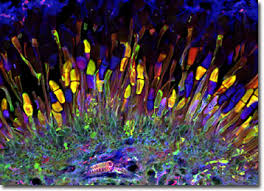
In autofluorescence microscopy, infected leaf tissues exhibit distinct fluorescence patterns arising from fungal structures and altered plant cell walls, enabling visualization of host–pathogen interactions without additional staining.