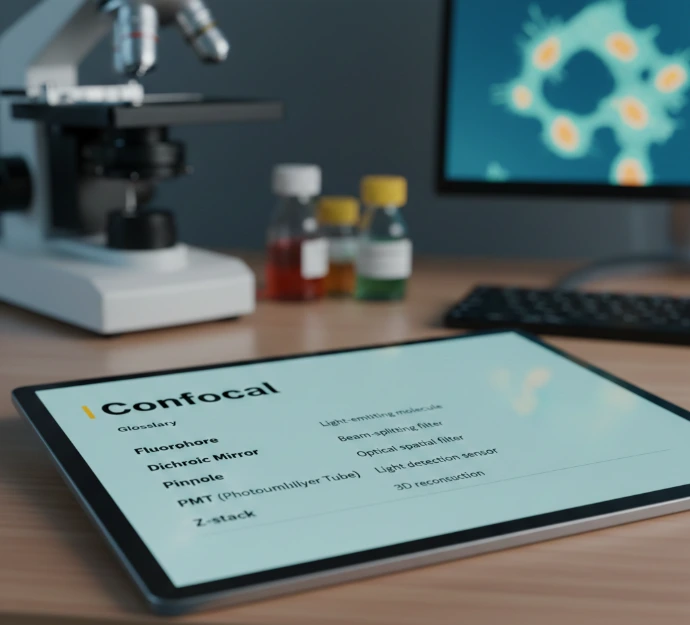
Confocal Glossary
Welcome to the Glossary of Terms in Fluorescence and Confocal Microscopy
The terminology of fluorescence microscopy can be complex, even for experienced researchers. This guide provides a clear, up-to-date reference for fluorescence and laser scanning confocal microscopy.
Absorbance (Optical Density) – Measures the quantity of light absorbed by a chemical or biological sample, typically using a spectrophotometer. Expressed as the logarithm of the reciprocal transmittance, absorbance indicates how much incident light is blocked by a sample. Absorption spectra often span wide wavelength ranges and are plotted as intensity, transmission, or optical density versus wavelength.
Acousto-Optic Tunable Filter (AOTF) – A precision optical filter that uses acoustic waves to dynamically select specific wavelengths from a light source. A crystal (e.g., quartz or tellurium oxide) is modulated by sound waves to create periodic refractive index changes, functioning as a diffraction grating. By adjusting acoustic frequency, AOTFs enable rapid, tunable wavelength selection for lasers or arc-lamp illumination in advanced imaging systems.
Acridine Orange – A nitrogen-containing heterocyclic fluorophore that intercalates into DNA and RNA, producing strong broad emission from green to red wavelengths. Excitation occurs via blue-green lasers (488 nm) or UV to blue lamp filters. While excellent for visualizing cellular structures, its broad spectrum limits simultaneous multi-probe imaging.
Alexa Fluor Dyes – A family of synthetic fluorescent dyes optimized for high photostability and broad spectral coverage, extending from UV through visible light to near-infrared. Widely used for labeling antibodies, nucleic acids, proteins, lipids, and cytoskeletal components, these dyes enable long-term imaging with minimal photobleaching.
Attenuation (Blocking) Level – The reduction of light intensity in a specific wavelength or range before detection. In fluorescence microscopy, attenuation is quantified as optical density or relative intensity and is critical for controlling excitation intensity or preventing detector saturation.
Autofluorescence (Primary Fluorescence) – Intrinsic fluorescence emitted by biological materials without external labeling. Common sources include NADH, FAD, flavins, cytochromes, porphyrins, chlorophyll, and lignin. Autofluorescence can interfere with imaging but also provides structural or metabolic information, especially when using UV or blue excitation.
Automated Fluorescence Image Cytometry (AFIC) – Combines fluorescent probes with computer-controlled microscopy to enable rapid, high-throughput analysis of stained specimens. AFIC allows quantitative detection of cellular markers, disease-related molecules, or nucleic acids with high sensitivity and signal-to-noise ratios.
Average Transmission – In optical filters, this describes the mean level of light transmitted across the intended spectral band. For bandpass filters, it is measured over the full width at half maximum (FWHM). For longpass or shortpass filters, it refers to transmission beyond the cut-on or below the cut-off wavelength.
Background – Non-specific light detected alongside the desired fluorescence signal. Sources include filter crosstalk, fluorophore bleed-through, autofluorescence, non-specific staining, pinhole artifacts, and camera noise. Minimizing background is critical for maximizing contrast and signal fidelity.
Bandpass Filter – Transmits a defined wavelength range while blocking shorter and longer wavelengths. The central wavelength (CWL) and FWHM define the spectral window. Bandpass filters are primarily used for excitation but can also serve as emission filters in fluorescence imaging.
Barrier (Emission) Filter – Designed to transmit fluorescence emitted by the sample while blocking residual excitation light. Constructed from colored glass or multi-layer interference coatings, these filters are paired with excitation filters and dichroic mirrors to optimize signal detection.
Beamsplitter – An optical device that divides an incident light beam into multiple paths. In fluorescence microscopy, dichroic mirrors selectively reflect excitation wavelengths toward the sample and transmit emission to detectors or eyepieces. Polarizing beamsplitters are used to produce linearly polarized light for specific contrast techniques.
Bioluminescence – A biochemical process where chemical energy is converted into visible light via enzymatic oxidation. A classic example is firefly luminescence, where luciferase catalyzes the reaction of luciferin with oxygen in the presence of ATP. Bioluminescence occurs widely in marine organisms and insects and is used in modern molecular imaging and biosensing applications.
Bleedthrough (Crossover) – The unwanted transmission of light through a filter designed to block it. Bleedthrough occurs when filter designs fail to achieve complete wavelength suppression or when the excitation and emission spectra of fluorophores overlap. It can compromise multi-label imaging but is minimized with carefully matched filter sets and spectral unmixing algorithms.
Coherent Anti-Stokes Raman Scattering (CARS) Microscopy – A label-free imaging technique that exploits molecular vibrational resonances. Two synchronized pulsed lasers (typically near-infrared) interact with a sample to produce a new anti-Stokes signal at a higher energy wavelength. CARS allows high-resolution 3D chemical imaging without fluorescent labels, making it ideal for studying biomolecules, lipids, and cellular dynamics.
Coherent Light – Light in which all waves maintain a fixed phase relationship. Coherence is necessary for laser applications and interferometric imaging. Highly coherent light is monochromatic and often linearly polarized, which is fundamental for confocal, multiphoton, and holographic microscopy.
Cold Mirror – A dichromatic interference mirror designed to reflect visible wavelengths while transmitting infrared light. Cold mirrors operate efficiently over a wide temperature range and are used in laser systems to separate visible excitation from infrared emissions.
Collector Lens – Positioned between the light source and illuminator in widefield fluorescence microscopes, the collector lens captures and focuses light from an arc-discharge lamp onto the specimen. Modern systems allow fine adjustment for Köhler illumination, ensuring uniform and efficient excitation.
Colored Glass Filters – Optical filters made from glass doped with colloids or metals to selectively absorb certain wavelengths while transmitting others. Once widely used for excitation and emission control, they remain relevant for blocking UV or IR light and in combination with modern interference filters.
Confocal Laser Scanning Microscopy (CLSM) – A high-resolution optical microscopy technique in which a focused laser is raster-scanned across a specimen. A pinhole in the emission path blocks out-of-focus light, enabling optical sectioning along the z-axis. CLSM produces sharp, high-contrast 3D images and is widely applied in cell biology and neuroimaging.
Composite View (Projection View) – A digitally reconstructed image generated by stacking multiple optical sections along the z-axis. Confocal or multiphoton microscopy allows accurate 3D visualization, overcoming the blur associated with widefield imaging of thick specimens.
Crosstalk – Signal interference occurring when excitation or emission from one fluorophore is detected in another fluorophore’s channel. Minimizing crosstalk is critical for multi-label imaging and can be achieved via optimized filter sets, spectral separation, and linear unmixing algorithms.
Cyanine Dyes (Cyanine Fluorochromes) – Synthetic fluorophores containing a polymethine chain with heterocyclic end groups. Cyanine dyes are highly photostable, water-soluble, and tunable across the visible and near-infrared spectrum. They are widely used for labeling nucleic acids, proteins, and subcellular structures in advanced fluorescence assays.
Deconvolution Fluorescence Microscopy – Computational technique that removes out-of-focus light from z-stacks of fluorescence images. Deconvolution improves resolution and contrast, enabling clearer 3D reconstructions and quantitative analysis of cellular structures. Requires precise motorized stage movement and accurate optical modeling of the microscope point spread function (PSF).
Descanning – In confocal microscopy, the process by which emitted light retraces its path back through scanning mirrors to the detector. Proper descanning ensures the fluorescence spot remains stable at the pinhole, allowing high-fidelity image acquisition without wobble artifacts.
Dichromatic Beamsplitter (Dichroic Mirror) – An interference-based optical element that selectively reflects short-wavelength excitation light toward the specimen while transmitting longer-wavelength emission to the detector. Central to fluorescence filter cubes, dichroics provide high excitation efficiency (>90%) and emission transmission (>90%) for multi-color imaging.
Dwell Time – The duration a laser beam remains on a single pixel during raster scanning in confocal microscopy. Short dwell times reduce photobleaching but may lower signal-to-noise ratio; longer dwell times increase signal intensity but risk photodamage in live-cell imaging. Optimized dwell time balances image quality with specimen preservation.
Electronic State – The configuration of electrons in an atom or molecule, determining its energy, molecular geometry, and charge distribution. Molecules primarily exist in the ground state at room temperature. Absorption of photons promotes electrons to higher-energy excited states, which can then relax via emission or non-radiative processes.
Emission Spectrum – The range of wavelengths emitted by a fluorophore after excitation. Typically, emission occurs at longer wavelengths than excitation due to energy loss (Stokes shift). The emission spectrum is independent of the excitation wavelength, allowing consistent imaging once the fluorophore is activated.
Epi-Illumination (Reflected Light) – An illumination technique in which the light source is positioned on the same side as the objective. A dichromatic mirror directs excitation light onto the specimen and transmits emitted fluorescence to the detector, enabling efficient imaging of reflected light and fluorescence simultaneously.
Excitation (Exciter) Filter – The first element in a matched fluorescence filter set, selecting a narrow band of wavelengths from a broadband source (e.g., mercury or xenon lamp) to excite the fluorophore. Typically implemented as bandpass interference filters or colored glass filters.
Excitation Spectrum – The range of wavelengths capable of inducing fluorescence in a fluorophore. Determined by scanning across the absorption spectrum while monitoring emission at a fixed wavelength. Although often overlapping with the absorption spectrum, excitation spectra are broadened by vibrational and rotational relaxation.
Filter Slope – Describes the sharpness of the transition between transmission and blocking in an optical filter. Steep slopes transmit a narrow wavelength range with high selectivity, whereas shallow slopes allow a broader transition. Critical in multi-color fluorescence to minimize spectral overlap.
Fluorescence – The rapid emission of a photon from a molecule that has absorbed light, typically occurring within nanoseconds. Excitation promotes an electron to a singlet excited state, and emission occurs via a spin-allowed transition back to the ground state.
Fluorescence Anisotropy – Measures the polarization of emitted light relative to the excitation vector, reflecting fluorophore rotational mobility. Changes in anisotropy reveal information about local viscosity, molecular binding, or protein dynamics.
Fluorescence Correlation Spectroscopy (FCS) – A technique for quantifying molecular dynamics in extremely small volumes (~femtoliters). Temporal fluctuations in fluorescence intensity reveal diffusion coefficients, molecular concentrations, aggregation, and chemical reaction rates. Compatible with confocal or multiphoton microscopes.
Fluorescence and DIC Combination Microscopy – Integrates fluorescence and differential interference contrast imaging to map labeled molecules within the cellular architecture. DIC uses polarized transmitted light and birefringent optics to enhance structural contrast, while fluorescence provides chemical specificity; images are combined digitally.
Fluorescence Filter Set – An optical block containing an excitation filter, dichromatic mirror, and emission (barrier) filter. Optimized to maximize fluorophore excitation and emission collection while minimizing crosstalk between multiple channels.
Fluorescence in situ Hybridization (FISH) – A molecular technique where fluorescently labeled nucleic acid probes hybridize to complementary DNA sequences. Direct FISH attaches fluorophores to probes; indirect FISH uses labeled antibodies to amplify the signal. Enables localization of genetic sequences in chromosomes or tissues.
Fluorescence Lifetime – The average time a fluorophore remains in an excited state before returning to the ground state. Lifetime measurements are independent of fluorophore concentration and can reveal environmental effects such as pH, polarity, or quenching interactions.
Fluorescence Lifetime Imaging Microscopy (FLIM) – Maps spatial variations in fluorescence lifetime across a specimen, providing environmental and biochemical information with subcellular resolution. FLIM is robust against variations in fluorophore concentration or photobleaching.
Fluorescence Loss in Photobleaching (FLIP) – A method to study molecular diffusion in living cells by repeatedly photobleaching a defined region and monitoring the decrease of fluorescence in surrounding areas. Provides information about mobility and connectivity of fluorescently labeled molecules.
Fluorescence and Phase Contrast Combination Microscopy – Couples phase contrast with fluorescence imaging to simultaneously visualize unlabeled structural features and fluorophore distributions. Phase contrast requires a ring-shaped condenser aperture and objective phase plate, with images digitally overlaid with fluorescence for structural mapping.
Fluorescence Recovery After Photobleaching (FRAP) – Measures lateral diffusion of molecules by photobleaching a small region and monitoring the recovery of fluorescence. Provides quantitative data on molecular mobility, membrane dynamics, and protein interactions in living cells.
Fluorescence Resonance Energy Transfer (FRET) – Detects molecular interactions at nanometer scales by energy transfer between donor and acceptor fluorophores. Time-resolved or steady-state FRET microscopy enables quantitative mapping of protein-protein or protein-nucleic acid interactions in live cells.
Fluorescence Microscopy – Optical microscopy based on selective excitation and detection of fluorophores. Modern systems use reflected light illumination with filter sets, dichroic mirrors, and detectors optimized to separate excitation and emission wavelengths, providing high-contrast images of labeled molecules.
Fluorochrome – A natural or synthetic fluorescent molecule capable of emitting light upon excitation. Commonly polynuclear heterocycles with delocalized electrons and reactive groups for conjugation to biomolecules.
Fluorophore – The functional domain of a molecule responsible for fluorescence. Intrinsic fluorophores occur naturally; extrinsic fluorophores are added to samples. Often a small aromatic fluorochrome attached to a larger biomolecule (e.g., fluorescein-labeled antibodies).
Franck-Condon Principle – Governs the electronic transitions in fluorescence, assuming that nuclei remain stationary during electronic excitation. Transitions are most probable where the overlap between ground and excited state electron distributions is maximal.
Full Width at Half Maximum (FWHM) – Defines the bandwidth of light transmitted by a filter. The FWHM is the wavelength range over which transmittance is at least 50% of maximum. Center wavelength (CWL) is the mean of this range. Critical in selecting filters for specific fluorophores in multi-channel imaging.
Harmonic Generation Microscopy (HGM) – A nonlinear imaging technique where two or more photons interact coherently with a specimen to generate higher harmonics (primarily second and third) without photon absorption. Second harmonic generation (SHG) produces coherent light at half the excitation wavelength. Ideal for imaging non-centrosymmetric structures, HGM preserves phase information and enables label-free, high-resolution imaging of transparent biological tissues.
Hot Mirror – A dichromatic interference filter that reflects infrared (750–1250 nm) while transmitting visible light. Hot mirrors protect optical components from thermal damage and can function as dichromatic beamsplitters in fluorescence systems. Their incidence angle can typically range from 0° to 45°.
Immunofluorescence Microscopy – Fluorescence microscopy targeting specific biomolecules using fluorescently labeled antibodies. Direct immunofluorescence employs a fluorophore-conjugated primary antibody, while indirect immunofluorescence uses a labeled secondary antibody for signal amplification. This technique enables precise localization of proteins, nucleic acids, and other antigens in cells and tissues.
Intensifier Silicon-Intensifier Target (ISIT) Camera – A low-light imaging device combining a silicon-intensifier target (SIT) tube with an image intensifier. ISIT cameras amplify weak fluorescence signals, enabling real-time visualization of specimens with low quantum yield.
Interference Filter – A multilayer optical filter engineered to transmit or reflect specific wavelengths through constructive and destructive interference. Used extensively in fluorescence microscopy to isolate excitation and emission bands, interference filters provide high spectral precision and sharp cutoff characteristics.
Intrinsic Lifetime – The natural decay time of an excited fluorophore in the absence of quenching or non-radiative processes. The intrinsic lifetime is inversely proportional to the rate constant of fluorescence decay and serves as a reference for calculating quantum yield.
Isosbestic Point – A wavelength at which the absorbance or emission intensity of a mixture of two interconverting species remains constant during a chemical or physical reaction. Observed in ratiometric dyes (e.g., fura-2 for calcium imaging), isosbestic points allow quantitative measurements independent of probe concentration.
Jablonski Diagram – A schematic representation of electronic and vibrational energy states of a fluorophore. Vertical lines depict excitation and emission transitions; wavy lines represent non-radiative processes like vibrational relaxation or internal conversion. Diagonal lines illustrate intersystem crossing between singlet and triplet states.
Liquid Crystal Tunable Filter (LCTF) – A voltage-controlled optical filter using liquid crystal birefringence to selectively transmit desired wavelengths. Combined with polarizers and waveplates, LCTFs allow rapid, tunable spectral selection without moving parts, suitable for multi-channel fluorescence imaging.
Longpass (LP) Filter – An optical filter that transmits wavelengths longer than a defined cutoff while blocking shorter wavelengths. Longpass filters are commonly integrated into dichromatic mirrors and barrier filters to isolate emission light from excitation sources.
Luminescence – Light emission from a substance due to electronic excitation via chemical, photonic, thermal, or mechanical mechanisms. Includes fluorescence, phosphorescence, chemiluminescence, bioluminescence, and triboluminescence.
Microchannel Plate (MCP) – A photon-to-electron amplifier composed of an array of capillaries with metallized walls. MCPs amplify weak photoelectron signals in image intensifiers, enabling detection of extremely low-light emissions in fluorescence microscopy.
Mirror Image Rule – The observation that fluorescence emission spectra often mirror the excitation spectra when plotted in wavenumber space. This reflects similar vibrational energy distributions between the ground and excited electronic states, guiding fluorophore selection for multi-color imaging.
Molar Extinction Coefficient (ε) – A measure of a molecule’s light absorption efficiency at a specific wavelength, expressed as absorbance per molar concentration per centimeter path length. Essential for quantitative fluorescence and spectroscopy calculations.
Monochromatic Light – Light composed predominantly of a single wavelength, typically produced by lasers or narrowband filters. True monochromaticity is idealized, as all sources exhibit a finite spectral bandwidth due to the Heisenberg uncertainty principle.
Multiple Fluorescence Filter Set – A specialized optical assembly allowing simultaneous imaging of multiple fluorophores. Designed to reduce registration errors and image shifts, these sets balance spectral overlap and crosstalk but may offer slightly reduced performance compared to individual single-probe filters.
Neutral Density (ND) Filter – A spectrally neutral filter that attenuates light intensity without altering its spectral composition. Commonly used to control high-intensity illumination from arc lamps in fluorescence microscopy.
Nipkow Disk – A spinning disk containing thousands of pinholes for parallel confocal imaging. The disk enables rapid optical sectioning with reduced photobleaching compared to single-point scanning, suitable for live-cell fluorescence microscopy.
Peltier Thermoelectric Cooling – A solid-state cooling technology based on the Peltier effect, in which an electric current passing through a junction of dissimilar semiconductor materials induces heat absorption at one surface and heat dissipation at the opposite surface. In fluorescence microscopy cameras, Peltier devices are used to cool charge-coupled device (CCD) sensors typically 50–60 °C below ambient temperature, thereby reducing thermally generated dark current and associated noise. This permits longer integration times with improved signal-to-noise performance.
Phosphorescence – A photophysical process involving radiative decay from an excited triplet electronic state (T₁) to the singlet ground state (S₀). Because the T₁→S₀ transition is spin-forbidden under quantum mechanical selection rules, phosphorescence lifetimes are significantly longer than fluorescence lifetimes, typically ranging from milliseconds to seconds. Phosphorescence is commonly suppressed in fluid solutions at room temperature due to collisional quenching.
Photobleaching (Fading) – The irreversible loss of fluorescence resulting from photochemically induced molecular damage during excitation. Photobleaching frequently involves intersystem crossing to the triplet state, followed by reactions with molecular oxygen or other reactive species that chemically modify or destroy the fluorophore. The rate of photobleaching depends on excitation intensity, oxygen concentration, and fluorophore stability.
Photomultiplier Tube (PMT) – A vacuum-based photon detection device that converts incident photons into amplified electrical signals via the photoelectric effect and secondary electron multiplication. Photons striking the photocathode release electrons, which are accelerated toward a series of dynodes, each producing additional electrons through impact ionization. PMTs provide extremely high gain and sensitivity but do not produce spatially resolved images.
Pinhole – In confocal microscopy, a spatial aperture positioned in a conjugate image plane to reject out-of-focus fluorescence, thereby enabling optical sectioning and improved axial resolution. In optical filter fabrication, a pinhole refers to a localized defect in thin-film coatings caused by particulate contamination, resulting in unintended light transmission.
Polychromatic Mirror (Polychroic Beamsplitter) – A multilayer dielectric beamsplitter engineered to reflect multiple excitation wavelength bands while transmitting corresponding fluorescence emission bands. These mirrors are essential in multicolor fluorescence microscopy for simultaneous imaging of multiple fluorophores without mechanical filter exchange, minimizing registration errors.
Quantum Efficiency (QE) – The ratio of photoelectrons generated to incident photons at a specific wavelength for a photodetector. QE is wavelength-dependent and reflects the detector’s photon-to-electron conversion effectiveness. In silicon-based sensors such as CCDs, QE is influenced by absorption depth, surface coatings, and interference effects within thin-film layers.
Quantum Yield (Φ) – The efficiency of fluorescence emission defined as the ratio of photons emitted to photons absorbed. Quantum yield values range from 0 to 1 and reflect the probability that excitation results in radiative decay rather than non-radiative relaxation. It is highly sensitive to environmental variables including solvent polarity, pH, and molecular interactions.
Quenching – Any process that decreases fluorescence intensity through non-radiative deactivation of the excited state. Mechanisms include collisional (dynamic) quenching, static complex formation, resonance energy transfer, and environmental effects such as changes in pH or ionic strength. Quenching reduces both fluorescence intensity and, in some cases, excited-state lifetime.
Red Fluorescent Protein (RFP) – A genetically encoded fluorescent protein derived from marine anthozoans (genus Discosoma) that emits in the red spectral region. RFP and its engineered variants are widely used as fusion tags for imaging protein localization, trafficking, and interactions in living cells via recombinant DNA expression systems.
Resonance Energy Transfer (RET) – A non-radiative process in which excitation energy is transferred from a donor fluorophore to an acceptor chromophore via long-range dipole–dipole coupling. Efficient transfer requires spectral overlap between donor emission and acceptor absorption and intermolecular separation typically less than 10 nm. RET efficiency is highly distance-dependent (∝ 1/r⁶).
Scratches and Digs – Standardized optical surface quality specifications describing linear defects (scratches) and localized imperfections such as pits or inclusions (digs). Measurements follow military or ISO standards, with numerical values indicating permissible defect dimensions in micrometers. Surface quality directly affects scattering and imaging performance.
Shortpass (SP) Filter – An optical filter that transmits wavelengths shorter than a defined cutoff wavelength while attenuating longer wavelengths. The cutoff is typically defined at 50% transmission. Shortpass filters are used in excitation pathways and dichroic assemblies in fluorescence microscopy.
Signal-to-Noise Ratio (S/N) – The ratio of detected signal magnitude to the statistical fluctuation (noise) associated with measurement. In photon-limited detection, noise approximates the square root of the total detected photon count. High S/N is critical for resolving low-intensity fluorescence signals against background.
Silicon-Intensifier Target (SIT) Camera – A low-light imaging device incorporating a photocathode and silicon target plate. Incident photons generate photoelectrons that are accelerated onto the silicon target to produce amplified charge signals, which are read by a scanning electron beam. SIT cameras are optimized for extremely weak fluorescence signals.
Singlet State – An electronic state in which all electron spins are paired, yielding a total spin quantum number S = 0 and multiplicity of 1 (2S + 1). Most ground-state organic molecules exist in the singlet configuration, and fluorescence typically arises from decay of an excited singlet state (S₁→S₀).
Steady-State Fluorescence – Fluorescence measurements performed under continuous excitation illumination, where excitation and emission processes reach dynamic equilibrium. Observed intensity reflects the balance between excitation rate and all deactivation pathways.
Stokes Shift – The spectral difference between excitation and emission maxima of a fluorophore, typically expressed in nanometers. The shift arises from vibrational relaxation and solvent reorganization prior to photon emission, resulting in lower-energy (longer-wavelength) emission relative to excitation.
Surface Flatness (Filters) – A quantitative measure of deviation of an optical surface from an ideal plane, expressed in fractions of a reference wavelength. Surface flatness affects wavefront quality and imaging fidelity, particularly in interference filters and dichroic mirrors.
Thin-Film Interference Coating – A multilayer dielectric or dielectric–metal structure fabricated with precise optical thicknesses (typically λ/4 or λ/2) to exploit constructive and destructive interference. These coatings enable wavelength-selective transmission and reflection in interference filters and dichroic mirrors.
Time-Resolved Fluorescence – A fluorescence measurement technique in which specimens are excited with short light pulses and emission decay kinetics are recorded with high temporal resolution. Fluorescence lifetimes, typically on the nanosecond scale, provide information on molecular environment and interactions.
Total Internal Reflection Fluorescence Microscopy (TIRFM) – An optical imaging method that utilizes an evanescent electromagnetic field generated at an interface under total internal reflection conditions. Only fluorophores within ~100–200 nm of the interface are excited, enabling selective visualization of membrane-associated or surface-proximal molecular events.
Transmitted Wavefront Distortion (TWD) – The deviation of a transmitted optical wavefront from planarity after passage through an optical element. TWD is expressed in fractions of a wavelength and results from surface irregularities and refractive index inhomogeneities.
Triplet State – An electronic state characterized by two unpaired electrons with parallel spins, yielding a spin quantum number S = 1 and multiplicity of 3. Triplet states are lower in energy than corresponding excited singlet states and are responsible for phosphorescence and many photochemical processes.
Two-Photon (Multiphoton) Microscopy – A nonlinear optical imaging technique in which fluorophores are excited by the near-simultaneous absorption of two or more lower-energy photons, typically from a pulsed infrared laser. Excitation is spatially confined to the focal volume due to the quadratic dependence on photon flux, enabling intrinsic optical sectioning and deep tissue imaging.
Olympus ix81 – An inverted research-grade microscope produced by Olympus, optimized for live-cell imaging with high-resolution objectives, motorized stage, and compatibility with fluorescence, DIC, and phase contrast techniques.
Reflected illumination – A microscopy lighting technique in which light is directed onto the specimen from above, reflected off its surface, commonly used for opaque or metallurgical samples to reveal surface structure.
Olympus microscopes – High-precision optical instruments manufactured by Olympus, designed for biological, clinical, and industrial applications, offering advanced imaging modalities including brightfield, phase contrast, and fluorescence.
Olympus fluorescence microscope – A microscope equipped with specialized filters and light sources that excite fluorophores in specimens, enabling the visualization of cellular structures and biomolecules with high specificity and contrast.
Body of microscope – The main structural component of a microscope that houses the optical system, including the tube, lenses, prisms, and often internal illumination pathways.
Where is the longitudinal fissure located – Refers to the midline deep groove in the cerebrum, called the longitudinal cerebral fissure, which separates the left and right cerebral hemispheres in the human brain.
Corn prop roots – Adventitious roots that emerge from the lower nodes of corn (Zea mays) stems, providing structural support and contributing to nutrient and water uptake.
Olympus bx51 – A research-grade upright microscope from Olympus, designed for brightfield, fluorescence, and polarizing microscopy, widely used in histology and pathology laboratories.
Trachyte porphyry – An igneous rock type characterized by large feldspar phenocrysts embedded in a fine-grained trachytic matrix, commonly studied in petrology for its formation processes.
Longitudinal fissure location – Anatomically, the deep groove located along the midline of the cerebrum, separating the right and left hemispheres and housing the falx cerebri of the dura mater.
Anatomy of the microscope – The study of the structural components of a microscope, including the eyepiece, objectives, stage, illuminator, condenser, and focusing mechanisms.
is a carrot a taproot – Yes; the carrot (Daucus carota) develops a primary thickened root called a taproot, specialized for storage of carbohydrates and anchoring the plant.
The longitudinal fissure – The principal deep sulcus in the cerebrum that divides the two cerebral hemispheres and contains meningeal structures, including the falx cerebri.
Selaginella strobilus labeled – Refers to the reproductive cone (strobilus) of Selaginella species, a lycophyte, which can be labeled in diagrams to identify microsporangia and megasporangia for educational purposes.
What is the longitudinal fissure – A central sulcus in the human brain, separating the left and right hemispheres and allowing passage of the falx cerebri, a dural membrane.
Magnifying parts of microscope – Components that increase image size, including the objective lenses and ocular (eyepiece) lenses, which work together to produce the total magnification.
Staminate cone – The male reproductive structure of gymnosperms, producing pollen grains within microsporophylls for wind-mediated fertilization.
Prop roots corn – Supportive roots arising from stem nodes of corn plants, stabilizing the plant and aiding in water and nutrient absorption.
Longitudal fissure – Likely a misspelling of “longitudinal fissure”; the deep midline groove separating the left and right cerebral hemispheres.
Longitudinal cerebral fissure – The anatomical cleft that divides the cerebral hemispheres, containing the falx cerebri and key vascular structures of the brain.
Longitudinal fissure of brain – The deep median sulcus that separates the cerebral hemispheres, critical in neuroanatomy for orientation and structural division of the cerebrum.