Plant Tissue
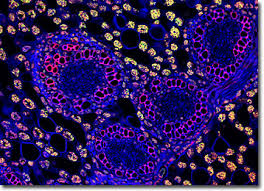
Acorus (Sweet Flag) – Stem Autofluorescence
Sweet flag refers to grass-like perennial plants belonging to the genus Acorus (family Acoraceae). These semi-aquatic plants typically grow in moist soils and shallow freshwater environments such as marshes, pond margins, and lake edges.
The leaves of sweet flag are long, narrow, and iris-like in appearance, and release a distinct aromatic scent when crushed. Flowering is relatively uncommon; when it occurs, the plant produces brownish-green cylindrical spikes. The fruit is a dry, berry-like structure containing a small number of seeds.
A key structural feature of sweet flag is its thick subterranean rhizome. This underground stem enables efficient vegetative propagation and enhances survival under harsh environmental conditions. The rhizomes possess a characteristic spicy fragrance and have historically been used in traditional medicine and ritual practices. Ancient Egyptians regarded them as aphrodisiacs, and several Native American tribes employed them for medicinal and ceremonial purposes.
Although sweet flag extracts were once incorporated into various herbal remedies worldwide, their medicinal use in the United States was discontinued in the late 1960s after studies suggested potential carcinogenic effects.
Autofluorescence in Sweet Flag Stem Tissue
In fluorescence microscopy, sweet flag stem tissue exhibits natural autofluorescence arising from intrinsic plant biomolecules such as:
Lignin in cell walls
Chlorophyll in plastids
Phenolic compounds
Structural polysaccharides
Autofluorescence imaging enables visualization of vascular bundles, cell wall organization, and structural differentiation without the need for external fluorochrome staining, making plant tissues particularly well-suited for label-free fluorescence studies.