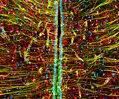
Rat Brain Tissue Sections
The rat brain is widely used as a model to study the complex anatomy and physiological mechanisms of the human brain. Research using rat brain tissue has contributed significantly to understanding neurological diseases such as dementia and Parkinson’s disease.
Brain tissue is organized into numerous major and minor regions, each with distinct anatomical and functional characteristics. Individual brain cells specialize by expressing a wide range of proteins, enzymes, transporters, and receptors.
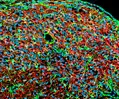
This digital image collection highlights several regions of the rat brain observed using immunofluorescence and laser scanning confocal microscopy in coronal, horizontal, and sagittal sections.
Key Brain Regions
Amygdala
A subcortical structure involved in emotional processing, particularly fear and anxiety, and part of the limbic system.
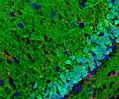
Blood Vessels
Networks of arteries and veins supply blood to the brain, including the internal carotid and vertebral arteries that form the Circle of Willis at the brain base.
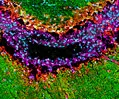
Cerebellum
Contains more than half of the brain’s neurons and is responsible for coordinating movement and maintaining motor control.
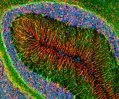
Cerebral Cortex
The outer layer of the brain responsible for higher cognitive functions. Unlike the highly folded human cortex, the rat cortex is relatively smooth.
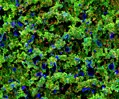
Dentate Gyrus
A key part of the hippocampal formation involved in memory processing and signal transmission to the CA3 region.
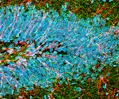
Hippocampus
A crucial brain structure for learning and memory, characterized by a simplified three-layer cellular organization.
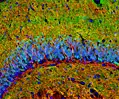
Hypothalamus
Regulates essential physiological processes such as body temperature, hormonal signaling, and autonomic responses.
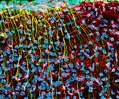
Lateral Ventricles
C-shaped cavities that contain cerebrospinal fluid produced by the choroid plexus.
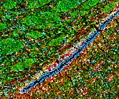
Longitudinal Fissure
A deep groove separating the left and right cerebral hemispheres, connected by the corpus callosum.

Medulla Oblongata
Controls vital autonomic functions including breathing, circulation, and digestion.
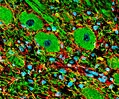
Pons
Links the cerebellum and other brain structures while coordinating movement, respiration, and sleep cycles.
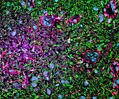
Striatum
A heterogeneous brain region involved in motor control and neurotransmitter regulation.
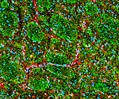
Thalamus
Acts as a central relay station for sensory and motor signals before they reach the cerebral cortex.
Third Ventricle
A narrow cavity within the ventricular system that connects several cerebrospinal fluid pathways in the brain.